Future of Logistics
A thriving logistics ecosystem must connect academic discovery with industrial execution. Delhivery is partnering with academia to tackle complex logistics problems.

Taslima Khan
5 min read

Key takeaways:
Academic collaborations have helped Delhivery create deployable solutions and evaluate emerging technologies before making significant investments.
Delhivery is now building a framework for sustained research to solve some of the industry's most complex challenges.
The research collaboration with IIT Delhi spans areas such as AI, operations research, and transportation engineering.
——
Some logistics problems cannot be solved within a product cycle. They require years of experimentation, deeper research and the ability to explore multiple approaches before arriving at solutions that can work at scale.
This understanding has led Delhivery to launch its largest academic research collaboration to date with IIT Delhi. The partnership for FY27 brings together eight faculty members across multiple departments to work on long-term research challenges spanning artificial intelligence, operations research and transportation engineering.
The collaboration marks a shift in Delhivery's approach to innovation: from short term consulting based projects to long term association for research on logistics problems.
The journey towards this began in 2020, when Delhivery started collaborating with academic institutions to solve specific operational challenges. The approach was focused: identify a problem, work with researchers who bring specialised expertise, implement solutions that deliver value, and apply those learnings across the network.
Delhivery's first academic collaboration, with IIT Bombay in 2020, focused on validating the design principles behind its mesh network architecture. The programme compared hub-and-spoke and hybrid hub-and-spoke models against Delhivery's mesh network on parameters such as speed and cost and demonstrated the inherent advantages of a mesh network for an express logistics network.
The collaboration also generated broader insights into network design, helping Delhivery understand where traditional hub-and-spoke models work best and where hybrid network structures can create greater efficiency.
In 2022, the collaboration with IIT Kharagpur moved beyond validating existing systems to solving one of Delhivery's most complex operational challenges: optimising its mid-mile logistics network.
Researchers from Delhivery and IIT Kharagpur developed a hybrid evolutionary search algorithm to solve a large-scale vehicle routing problem involving more than 3,000 locations, multiple hub configurations, different vehicle types, asymmetric road distances and strict delivery time windows. The algorithm automated key parts of network planning and operations, reduced computational complexity and helped identify more efficient routing strategies.
Implemented within Delhivery's production systems, the solution helped achieve cost savings and continues to support the company's mid-mile operations.
Beyond improving existing operations, academic collaborations have also helped Delhivery evaluate emerging technologies before making significant investments.
In 2023, its research collaboration with the University of New South Wales (UNSW Sydney) explored whether quantum computing could help solve complex transportation optimisation problems that are difficult for conventional computing methods. The work examined the potential of quantum annealing in addressing large-scale logistics problems and provided insights into the maturity and future applications of the technology.
“We wanted to understand where quantum computing has reached today and whether we need to wait for a few more years. The research showed that quantum computing holds significant potential, but the ecosystem and technology need to mature further before it can be applied at scale in logistics," says Kausik Tamuli, Senior Director, Operations Research at Delhivery.
Why Logistics Needs Academia?
Each engagement with premier academic institutions has brought new perspectives, challenged existing assumptions and helped Delhivery explore solutions that may not have emerged through conventional operational thinking alone.
Most importantly, they have revealed something more fundamental: academia could become a long-term innovation partner. Now, instead of commissioning isolated studies, Delhivery is building a framework for continuous research on some of the industry's most complex challenges.
So, while previous collaborations were essentially based on one problem statement, the collaboration with IIT Delhi is being approached as a longer-term engagement. It begins with three research programs expected to run over the next year, with the potential to continue over a longer period as new opportunities emerge.
The shift reflects a broader understanding of how innovation happens.
Inside technology companies, research is naturally shaped by business priorities. Engineering teams are expected to deliver solutions that create measurable value within defined timelines. Long-term experimentation can be difficult when outcomes are uncertain and business impact may take years to materialise.
Academic researchers operate differently.
Rohan Anand, Vice President Data Science at Delhivery says, "Internal teams are naturally focused on seeing impact within a shorter timeframe. But for academia, the research itself is the motivation, while impact becomes a valuable outcome of that research."
This makes universities uniquely suited for challenges that cannot be solved within a typical product roadmap.
"We have our own biases when solving problems. Collaborations help us look at the same problem from completely new perspectives," says Tamuli.
Building the Next Generation of Logistics Research
The IIT Delhi collaboration brings together eight faculty members across multiple departments to work on long-term research problems spanning artificial intelligence, operations research and transportation engineering.
The first phase focuses on three areas:
Building an AI-native mapping stack for India using operational telemetry and machine learning. https://www.delhivery.com/blog/series-finding-india-(part-i-of-ii)
Optimising scheduling for road-train operations through advanced mathematical models.
Orchestrating mixed fleets of diesel, CNG and electric vehicles by treating energy availability as a core planning constraint.
Collectively, these projects address challenges that could shape the next decade of logistics rather than the next product release.
Building Institutional Capability
For Delhivery, the significance of these collaborations extends beyond individual research outcomes.
Working with universities gives the company access to specialised expertise that would be difficult and expensive to build internally, while researchers gain access to one of India's largest logistics datasets and real-world operational challenges.
Some projects may eventually become production systems, as the IIT Kharagpur work already has. Others may influence network design, infrastructure planning or even public policy through peer-reviewed research.
The broader objective is to build institutional capability - a long-term research engine that continuously connects academic discovery with industrial execution.
By expanding this model across leading academic institutions, Delhivery aims to create an ecosystem where industry and academia work together to address the complex challenges that will define the future of logistics in India.
——
These are the popular topics you might want to check out
Latest blog posts
View all blogs
Supply Chain Insights
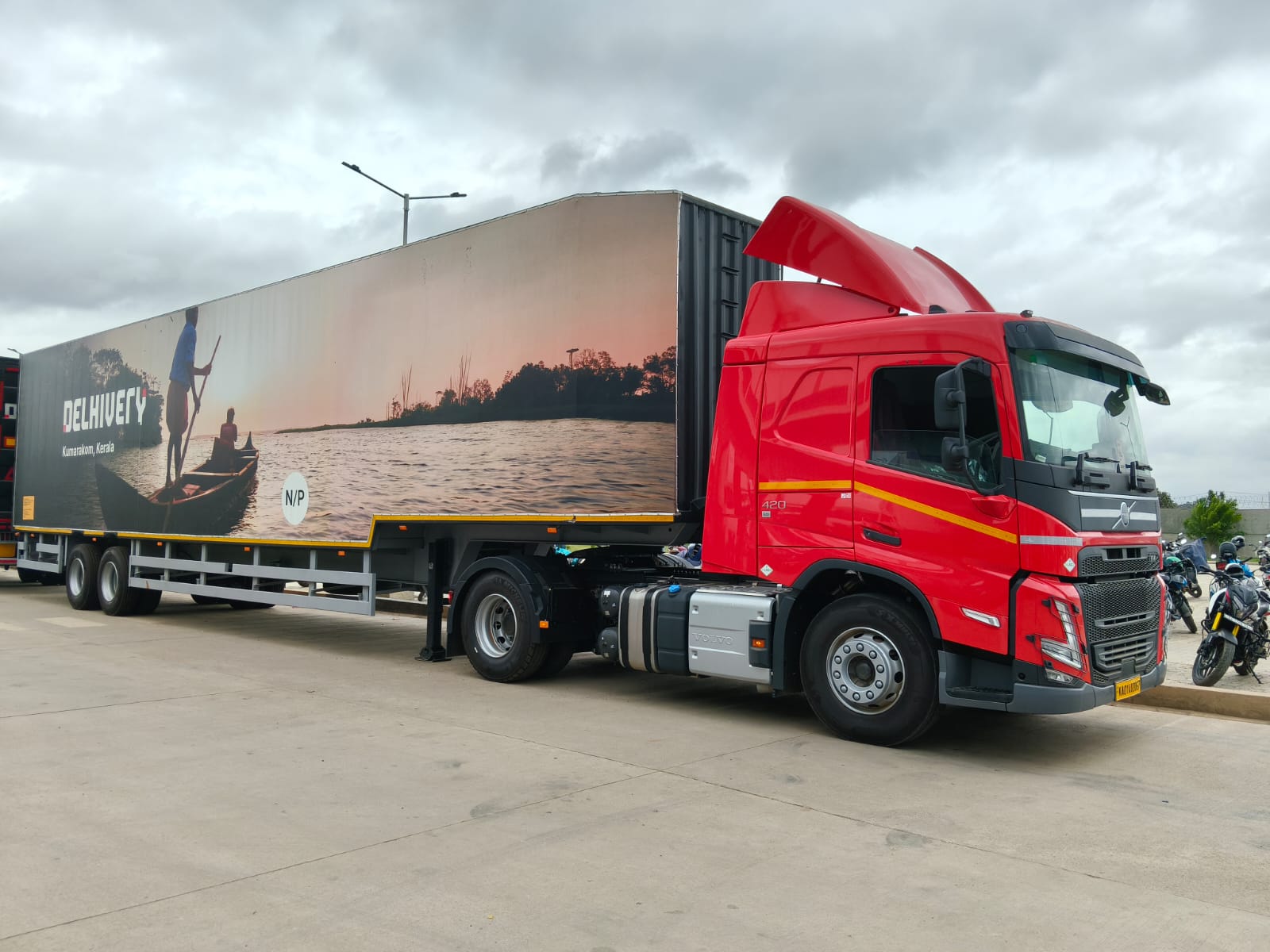
Power-Only Trucking: A Smarter Model for Long-Haul Freight
Smarter operating models can potentially make long-haul trucking with bigger trucks more efficient. Can Power-only trucking be a game-changer?
Taslima Khan
Engineering & Technology
Series: Finding India (Part I of II)
How a 15-member engineering team spent a decade using data generated by millions of deliveries and built a mapping platform for logistics.

Delhivery Engineering

Engineering & Technology
Series: Finding India (Part II of II)
How engineers taught machines to understand India’s complex addresses, transforming years of delivery data into a mapping intelligence platform built for logistics.
Delhivery Engineering
Ship with the largest integrated logistics company
Create your business account now
SERVICES
Delhivery One
Explore Now
Information Security Policy
Delhivery is committed to safeguarding the confidentiality, integrity and availability of all physical and electronic information assets of the organization. We ensure that the regulatory, operational and contractual requirements are fulfilled.
Disclaimer
Operational metrics listed are as of August 04, 2023